
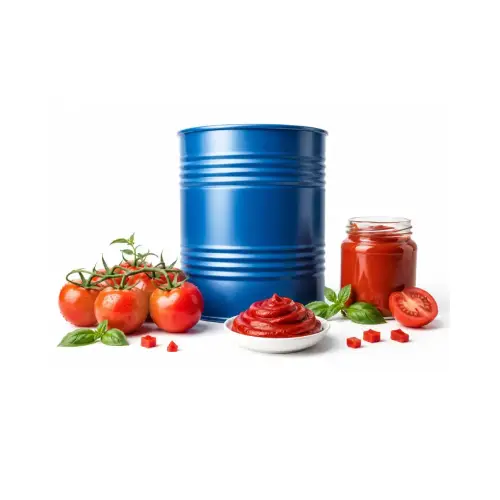
| Product Name | Aseptic Tomato Paste |
|---|---|
| Product Type | Concentrated Tomato Paste |
| Packaging | Aseptic Bulk Packaging |
| Supply Type | B2B / Bulk |
| Application | Food Manufacturing & Commercial Food Supply |
Aseptic Tomato Paste is a concentrated tomato product designed for food manufacturers, distributors, importers, and industrial food processing companies that require consistent quality, long shelf life, and reliable performance. Produced from carefully selected fresh tomatoes and packed using advanced aseptic technology, this product provides an efficient solution for large-scale food production and international distribution.
With its concentrated tomato flavor, natural color, and stable quality, Aseptic Tomato Paste is widely used as a key ingredient in ketchup, sauces, pizza toppings, ready meals, soups, canned foods, and many other processed food products.
Aseptic Tomato Paste is produced by concentrating fresh tomatoes after harvesting and then filling the concentrated product into sterilized packaging under controlled aseptic conditions.
The production process is designed to minimize microbial contamination while maintaining important characteristics of the tomato, including color, flavor, texture, and nutritional properties. Unlike many conventional packaging methods, aseptic packaging allows the product to remain commercially stable for an extended period without requiring refrigeration before opening, when stored under the recommended conditions.
This makes aseptic tomato paste particularly suitable for food manufacturers and exporters that need to transport and store large quantities of tomato paste efficiently.
The quality of Aseptic Tomato Paste starts with the quality of the raw tomatoes. Fresh, ripe tomatoes are selected according to defined quality standards and then processed shortly after harvesting.
The general production process includes several important stages:
Fresh tomatoes are carefully selected based on maturity, color, quality, and processing characteristics. High-quality raw materials are essential for achieving the desired color, flavor, acidity, and concentration of the final product.
The tomatoes are thoroughly washed to remove soil, dust, and other unwanted materials. They are then processed to separate the usable tomato material from seeds, skin, and other solid components.
The tomato juice or pulp is concentrated using controlled evaporation. During this stage, part of the natural water content is removed to increase the concentration of soluble solids, commonly measured in Brix.
Different Brix levels can be produced according to the requirements of the customer and the intended application.
The concentrated tomato paste undergoes controlled heat treatment designed to achieve the required commercial stability and microbiological safety.
After thermal processing, the tomato paste is filled into sterilized aseptic bags inside controlled processing conditions. The sealed bags are then placed inside suitable outer containers for transportation and storage.
This packaging method helps protect the product from external contamination throughout its shelf life.
The specifications of Aseptic Tomato Paste can vary depending on the tomato variety, production process, and customer requirements. Common parameters considered by industrial buyers include:
For international B2B transactions, product specifications should be clearly defined before purchase to ensure that the supplied tomato paste meets the technical requirements of the buyer’s production line.
Brix is one of the most important specifications when purchasing tomato paste for industrial use. It indicates the concentration of soluble solids in the product and directly affects how much paste is required in a final recipe.
Different food manufacturers may require different Brix levels depending on their formulation and production process.
For example, tomato paste with a higher Brix concentration may be suitable for manufacturers looking for a more concentrated ingredient, while a lower concentration may be preferred for specific formulations.
The appropriate Brix level should therefore be selected according to the final application, production process, and formulation requirements.
Aseptic packaging is one of the main advantages of this type of tomato paste. The product is commonly packed in food-grade aseptic bags and placed inside strong outer containers suitable for storage and transportation.
Industrial packaging formats can be selected according to customer requirements, shipping conditions, production needs, and destination market regulations.
Proper packaging provides several benefits, including protection against contamination, efficient transportation, easier warehouse handling, and extended product stability.
For exporters and importers, packaging is particularly important because tomato paste may travel long distances before reaching the final manufacturing facility.
One of the major benefits of Aseptic Tomato Paste is its extended shelf life when properly processed, packaged, transported, and stored.
The product should generally be kept in a clean, dry, and cool environment away from direct sunlight and sources of excessive heat. Storage conditions should always follow the manufacturer’s technical specifications and the requirements indicated on the product packaging.
Maintaining appropriate storage conditions is important for preserving the product’s quality, color, flavor, and overall stability.
Aseptic Tomato Paste is a versatile ingredient used in a wide range of food products. Its high concentration makes it particularly practical for industrial formulations.
Common applications include:
Food manufacturers can incorporate tomato paste into different formulations depending on the desired tomato intensity, color, viscosity, and nutritional profile.
For industrial food manufacturers, Aseptic Tomato Paste offers several practical advantages.
Extended stability: Aseptic processing and packaging provide excellent commercial stability when the product is stored correctly.
Efficient transportation: The concentrated form allows manufacturers to transport a significant amount of tomato solids in a relatively compact format.
Consistent quality: Industrial production under controlled conditions helps manufacturers achieve more consistent results between production batches.
Versatile application: Tomato paste can be used as a base ingredient in numerous food formulations.
Reduced refrigeration requirements: Before opening, properly processed aseptic tomato paste generally does not require refrigerated storage, provided that the recommended storage conditions are maintained.
Suitable for international trade: Long shelf life and durable packaging make the product well suited to export markets and large-scale distribution.
For B2B buyers, choosing a supplier is about more than simply purchasing tomato paste. Consistency, food safety, technical specifications, packaging quality, documentation, and delivery reliability can directly affect the buyer’s production process.
A reliable supplier should be able to provide clear technical specifications, appropriate food-grade packaging, batch information, quality documentation, and consistent product quality.
Buyers should also evaluate the supplier’s production capabilities, quality control procedures, export experience, and ability to meet specific requirements.
Aseptic Tomato Paste provides food manufacturers with a practical and efficient tomato ingredient for a wide range of industrial applications. Its concentrated format, aseptic packaging, extended shelf life, and versatility make it an important raw material for companies producing sauces, ketchup, ready meals, canned foods, and other tomato-based products.
Whether you are an importer, food manufacturer, distributor, or industrial buyer, selecting the right tomato paste requires careful attention to product specifications, packaging, quality standards, and supplier reliability.
With the right specifications and a dependable supply chain, Aseptic Tomato Paste can provide consistent performance and help food manufacturers maintain the quality of their finished products.
Reviews
There are no reviews yet.